
Buying a hitch looks simple until you open the catalog. Four-inch drop or six? What changes on a lifted truck? Is a 2.5-inch receiver just a bigger 2-inch receiver? Fixed ball mount or adjustable?
Most of that clears up once you stop shopping and start measuring. Plenty of mismatched setups connect fine and tow badly, so getting the trailer riding level on properly rated components is the actual goal.
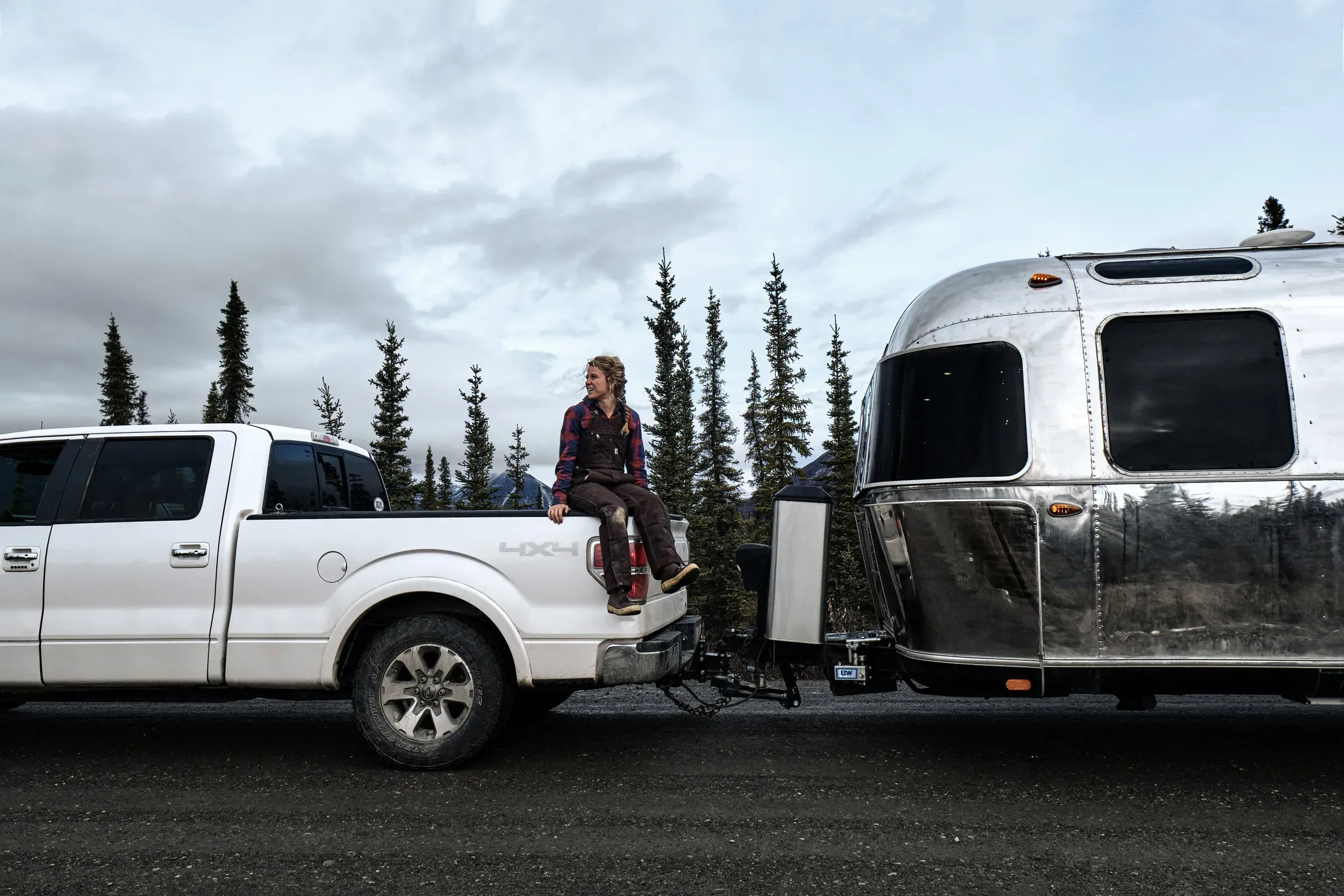
Measure the drop you need
Park the truck and trailer on level ground. This takes about five minutes.
Load the trailer first. Measure it the way you tow it, with water, gear, and cargo aboard. A trailer measured empty sits differently once it is loaded, and the drop you calculated will be wrong by however much the suspension settles.
Level it. Unhook and run the tongue jack up or down until the frame sits level. A small level on the frame or coupler is enough. Every measurement after this depends on it.
Measure the receiver. Ground to the top inside edge of the receiver opening on the truck. Say it comes to 24 inches.
Measure the coupler. Ground to the bottom of the coupler, trailer still level. Say 18 inches.
Subtract. 24 minus 18 is 6, so you need roughly 6 inches of drop. Had the coupler measured higher than the receiver, you would need that much rise.
Work out your drop
Load the trailer the way you tow it, park both on level ground, then level the trailer on its tongue jack before you measure. A trailer measured empty and towed loaded gives you the wrong number.
That is the same method Weigh Safe publishes for sizing one of its hitches. It is the number to walk into a parts counter with.
Then check what is left underneath
A hitch that puts the ball at the perfect height can still hang low enough to become the first thing that touches a steep driveway.
Weigh Safe recommends at least 11 inches from the lowest point of the hitch to the ground, in its words because “it is never fun hitting or scraping the bottom of your hitch while towing.” How close you come depends on your receiver height, not on the drop by itself. A lifted truck with a 32-inch receiver can run a 12-inch drop and still have plenty of room underneath. A low SUV with a 19-inch receiver runs out of room at 9.
That is why the calculator above works from both numbers rather than warning on drop size alone.
Start with receiver size
Check what the truck has before anything else. Common receiver openings are 2 inch, 2.5 inch, and 3 inch. Many half-ton pickups use 2 inch. Heavy duty trucks increasingly ship with 2.5 or 3.
Reducer sleeves exist and they physically work. We would rather match the shank to the receiver directly, because an adapter puts another joint in the load path and another rating to check. B&W builds Tow & Stow models for all three receiver sizes and Weigh Safe offers its drop hitch in 2, 2.5 and 3-inch shanks, so there is usually no reason to adapt at all.
Then check ball size
Easy to get wrong precisely because it seems too obvious to check.
Trailer balls come in 1-7/8 inch, common on small utility trailers; 2 inch, common on utility trailers, boats, and lighter campers; and 2-5/16 inch, common on larger campers and equipment trailers. The coupler almost always has its size stamped on it.
A quality adjustable hitch matters here because most of them carry two or three ball sizes at once. Pull a pin, rotate the head, and the same hitch takes a different trailer.
One adjustable hitch replaces a drawer full of ball mounts
Tow one trailer and only that trailer, and a fixed drop ball mount is a perfectly good answer.
The moment there are two trailers the math changes. A boat trailer might want 4 inches of drop where the equipment trailer wants 8. With fixed mounts that is a separate part for each, and the one you need tends to be the one sitting in the garage. An adjustable hitch covers the range and stays in the receiver.
| B&W Tow & Stow | Weigh Safe drop hitch | |
|---|---|---|
| Receiver sizes | 2“, 2.5“, 3“ | 2“, 2.5“, 3“ |
| Height adjustment | Multiple drop ranges by model | 4“, 6“, 8“, 10“ models, ~1“ increments |
| Ball sizes | Dual and tri-ball configurations | 2“ and 2-5/16“ included, 1-7/8“ separate |
| Tongue weight gauge | No | Built into the shank |
| Stows out of the way | Rotates under the bumper | Removable, no stow position |
| Runs as a rise | Invertible | Invertible, gains 1“ over the drop figure |
| Weight distribution | Not compatible per B&W | Separate True Tow product |
One note on that second-to-last row. Both hitches invert in the receiver to run as a rise, and Weigh Safe notes that inverting gains an inch on the drop figure, so a 4-inch drop becomes a 5-inch rise. Capacity varies a good deal by shank and ball size rather than by orientation: Weigh Safe publishes 7,500 to 12,500 lb GTW on a 2-inch shank against 18,500 lb on a 2.5-inch. Check the rating for the exact configuration you are buying rather than for the product family.
B&W Tow & Stow
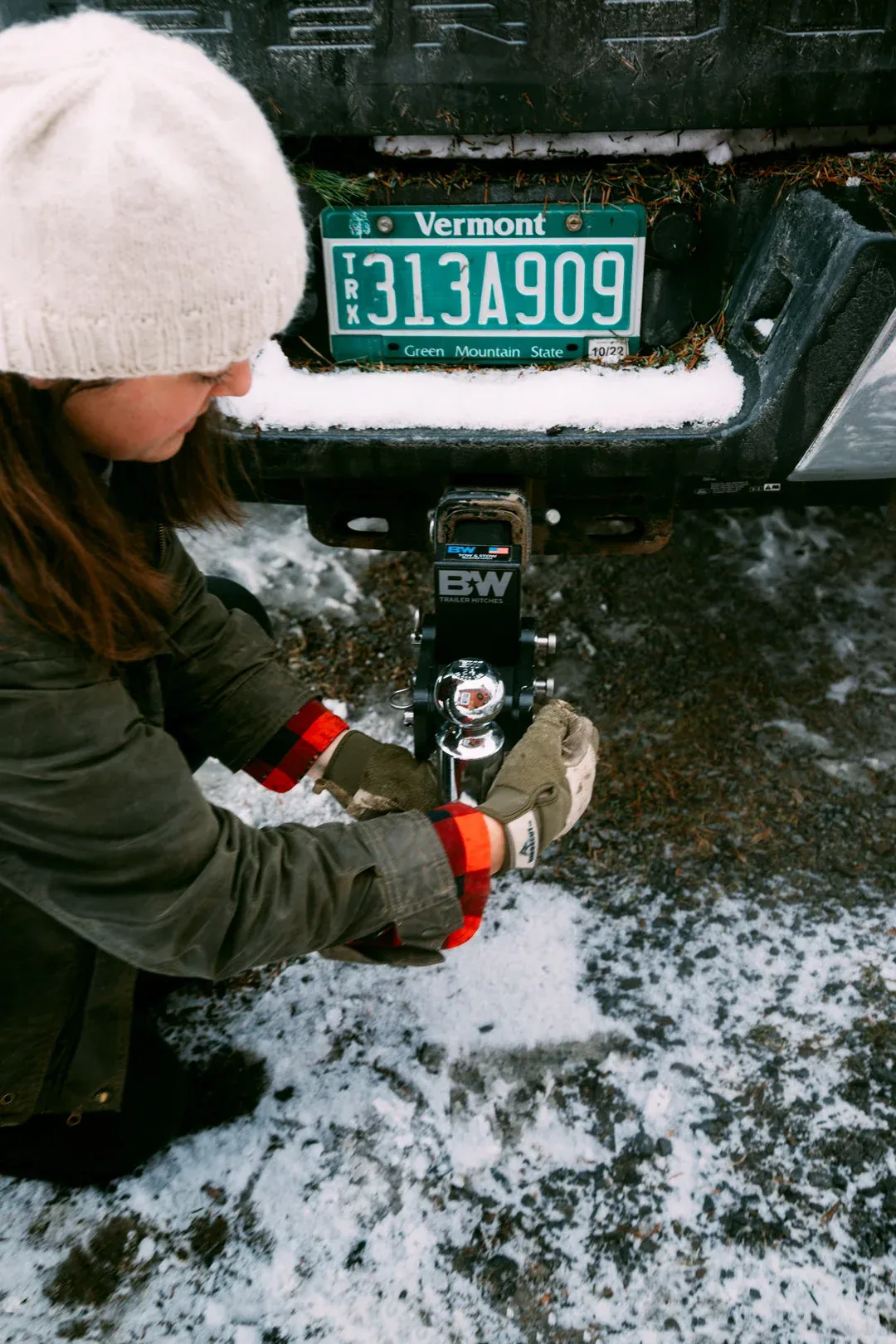
The stow matters more day to day than the adjustment. The ball assembly rotates and tucks behind the bumper when you are done towing, so nothing sticks out into the parking space and there is no loose part to lose.
It adjusts across several drop ranges depending on model, inverts for rise, and comes in dual and tri-ball configurations with 1-7/8, 2 and 2-5/16-inch balls. The model range runs wide because a stock-height sedan and a lifted three-quarter-ton need very different numbers.
If you drive a newer GM truck, one detail is worth knowing. B&W makes a Tow & Stow specifically for the MultiPro and MultiFlex tailgates, because a standard ball mount can foul the inner tailgate step when it folds down.
Weigh Safe drop hitch
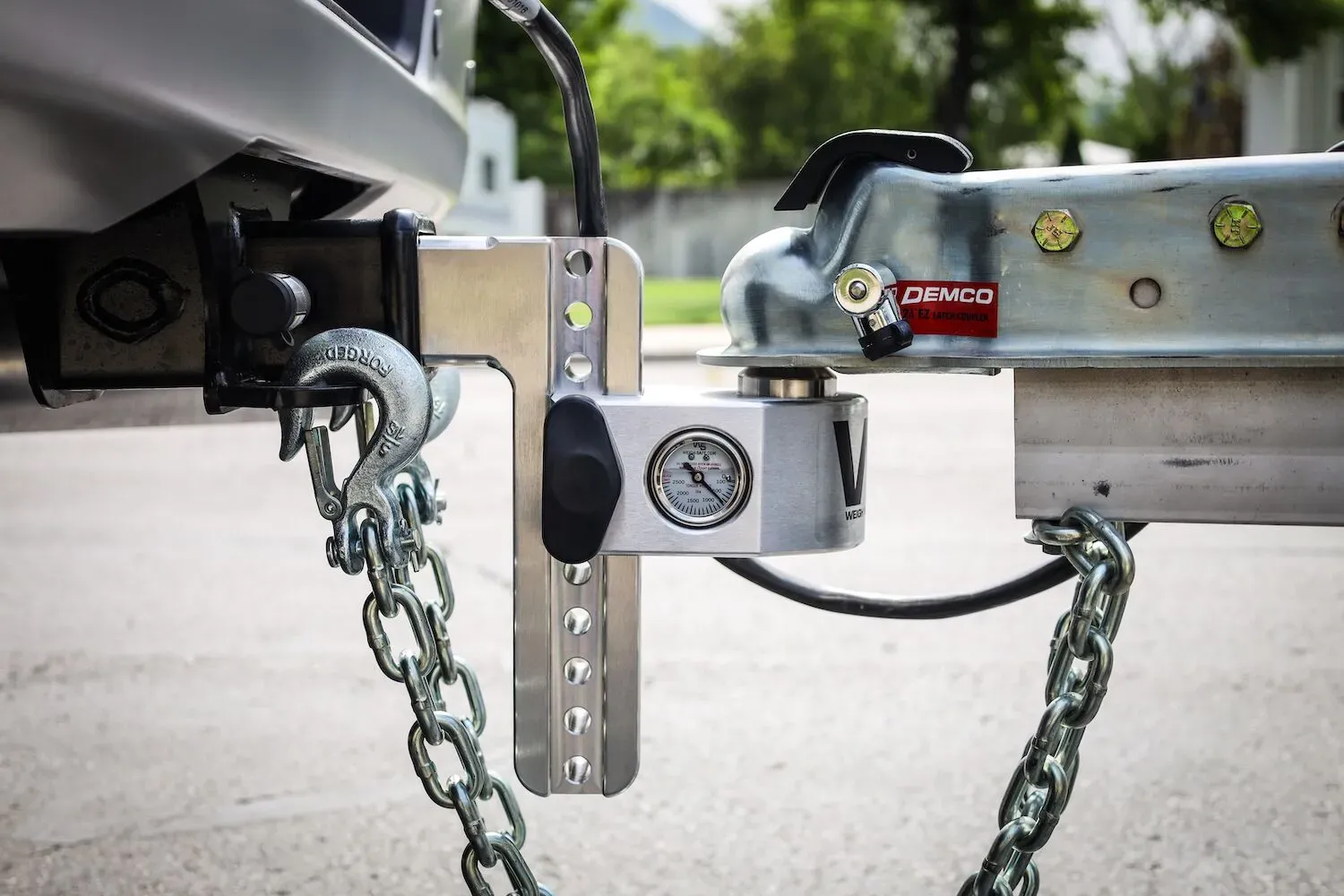
Weigh Safe puts a tongue weight gauge in the shank, so hooking up the trailer shows you roughly how much downward load it is putting on the ball.
That number is worth more than it sounds. CURT puts the target at 10 to 15 percent of gross trailer weight, and is specific about both failure modes: under 10 percent “the trailer may tend to sway back and forth,” over 15 percent “your vehicle may become less responsive, especially when turning and braking.” The truck, trailer and hitch requirements always come first. On a 7,000-pound loaded trailer that works out to somewhere around 700 to 1,050 pounds. Too little tongue weight makes a trailer more willing to sway. Too much loads the rear axle, the receiver, and your available payload.
Most owners estimate this and never check it. Weigh Safe’s drop hitch comes in 4, 6, 8 and 10-inch drops adjusting in 1-inch increments, in 2, 2.5 and 3-inch shanks, and ships with 2-inch and 2-5/16-inch stainless balls, with a 1-7/8-inch ball sold separately.
We recommend both, depending on the trailer
For a hitch that lives on the truck, folds out of the way, and covers several trailers with several ball sizes, the Tow & Stow.
For a load that moves around between trips, especially equipment, toys, or cargo that sits differently each time, the Weigh Safe. On a trailer whose balance changes, reading the tongue weight beats guessing at it.
Lifted and leveled trucks
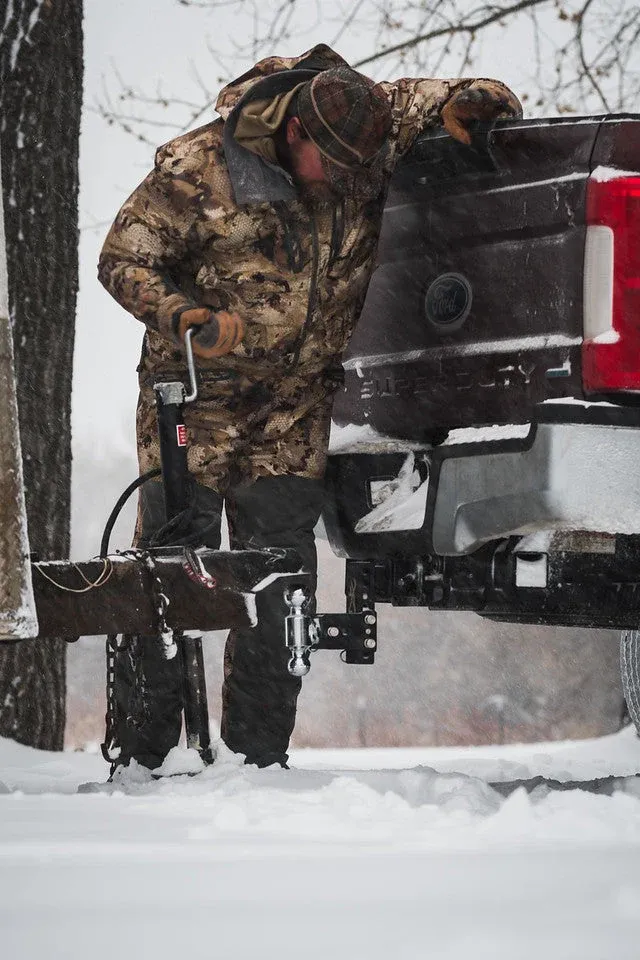
Lift the truck and the relationship between receiver and coupler changes. A truck that needed 3 inches of drop from the factory can need 6, 8, or more.
Do not size the hitch from the lift, though. Two trucks with identical kits can measure differently because of tire size, factory spring rate, what is riding in the bed, and the receiver’s own design. The lift tells you the number went up rather than what it went up to.
The rest of the connection
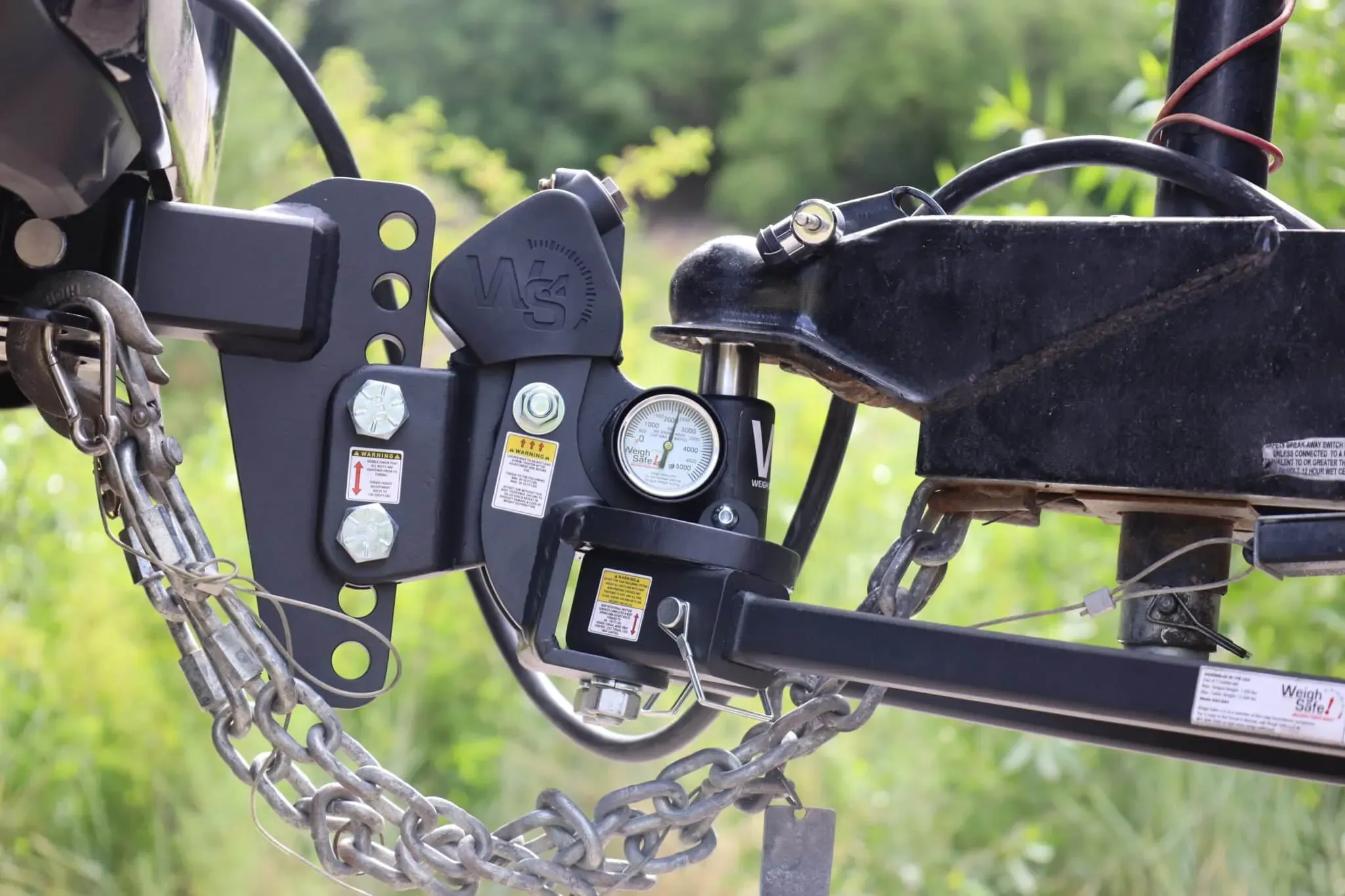
Sizing the hitch is one part of hooking up safely. Before you tow:
- Safety chains crossed under the coupler, with enough slack to turn and not enough to drag
- The hitch pin and clip actually installed, not resting on the tailgate
- The breakaway cable attached to the truck rather than to the safety chains
- Trailer brakes tested and adjusted. Colorado requires brakes on every trailer of 3,000 pounds gross weight or more (C.R.S. 42-4-223)
- Lights and wiring checked before you pull out
Our towing accessories guide covers brake controllers and the rest of the towing system in depth.
When a drop hitch is not the answer
A drop hitch solves height. Some trailers need a different tool entirely.
Larger bumper pull campers can want, or outright require, a weight distribution hitch. Spring bars move part of the tongue load back across the truck and trailer axles and restore weight to the front axle, and some systems add sway control. B&W is unambiguous about this on the Tow & Stow product page: “Sway-bar systems, along with weight distribution systems, utilize specialized attachment pieces to connect to the hitch receiver that are not compatible with the Tow & Stow.” So this is a different hitch rather than an add-on.
Air springs from Air Lift or Firestone help a truck carry tongue weight without sagging, which keeps the headlights pointed at the road. They do not raise payload, GVWR, or tow rating by a single pound. A truck that is overloaded before the bags is overloaded after them.
Once the trailer is large enough, the connection belongs in the bed near the rear axle instead of behind the bumper. That is gooseneck or fifth wheel territory.
Common mistakes
Almost every one of these is a skipped measurement.
- Sizing from the truck rather than the trailer. “I have an F-250, what drop do I need?” is unanswerable without the trailer, because receiver height and coupler height decide it together
- Measuring an empty trailer that gets towed loaded
- Buying maximum drop on the theory that more adjustment is more capability. It stops being capability once the hitch is scraping
- Reaching for an adapter instead of matching the receiver size
- Assuming the ball size rather than reading the coupler
- Treating the truck’s advertised tow rating as the answer. The lowest rating in the system governs: truck, receiver, ball mount, ball, coupler, trailer GVWR, actual loaded weight, tongue weight, and tires
- Using an adjustable ball mount where the trailer calls for weight distribution
Before you order
Seven things to know:
- Receiver size: 2, 2.5, or 3 inch
- Required drop or rise, measured with the trailer loaded
- Ball size stamped on the coupler
- Loaded trailer weight and tongue weight
- Whether you tow one trailer or several
- Whether the trailer requires weight distribution
- Whether the truck is lifted, leveled, or on larger tires
Common questions
What size drop hitch do I need?
Is a bigger drop hitch better?
Do I need a different drop hitch after lifting my truck?
Can I use a drop hitch with a weight distribution system?
What ball size does my trailer need?
Does a heavier-rated hitch let me tow more?
Where these numbers come from
Sources
Every specification and legal requirement on this page comes from the manufacturer or the statute itself. Checked 8 September 2026.
- B&W Trailer Hitches, Tow & Stow Adjustable Ball Mount: ball sizes and configurations, inversion for rise, and weight-distribution and sway-bar incompatibility
- B&W Trailer Hitches, MultiPro | MultiFlex Tow & Stow
- Weigh Safe, figuring out what size hitch you need: the measurement method and the 11-inch ground clearance recommendation
- Weigh Safe, Drop Hitch: drop sizes, adjustment increments, shank sizes, included balls, and capacity ratings
- CURT, trailer couplers and tongue weight: the 10 to 15 percent target and what happens either side of it
- C.R.S. 42-4-223: Colorado’s trailer brake requirement at 3,000 pounds gross weight
Ratings differ between models and configurations, and manufacturers revise them. Check the figures for the exact part number you are buying against your truck’s own ratings before you tow.
Towing equipment in Arvada, Colorado
Ride N’ Shine Automotive sells and installs B&W Tow & Stow and Weigh Safe adjustable hitches, weight distribution and sway control systems, trailer hitch receivers, gooseneck and fifth wheel hitches, Air Lift and Firestone air springs and Timbren SES, and onboard compressors. We fit them for truck owners in Arvada, Westminster, Thornton, and across Denver.
The terminology is worth keeping straight while you shop, because parts counters and websites use it loosely. The receiver hitch bolts to the truck. The ball mount, also called the drop hitch, slides into the receiver. The hitch ball connects to the coupler. All three need to be rated for the trailer and compatible with each other.
Bring the truck by, and the trailer too if you can get it here.