
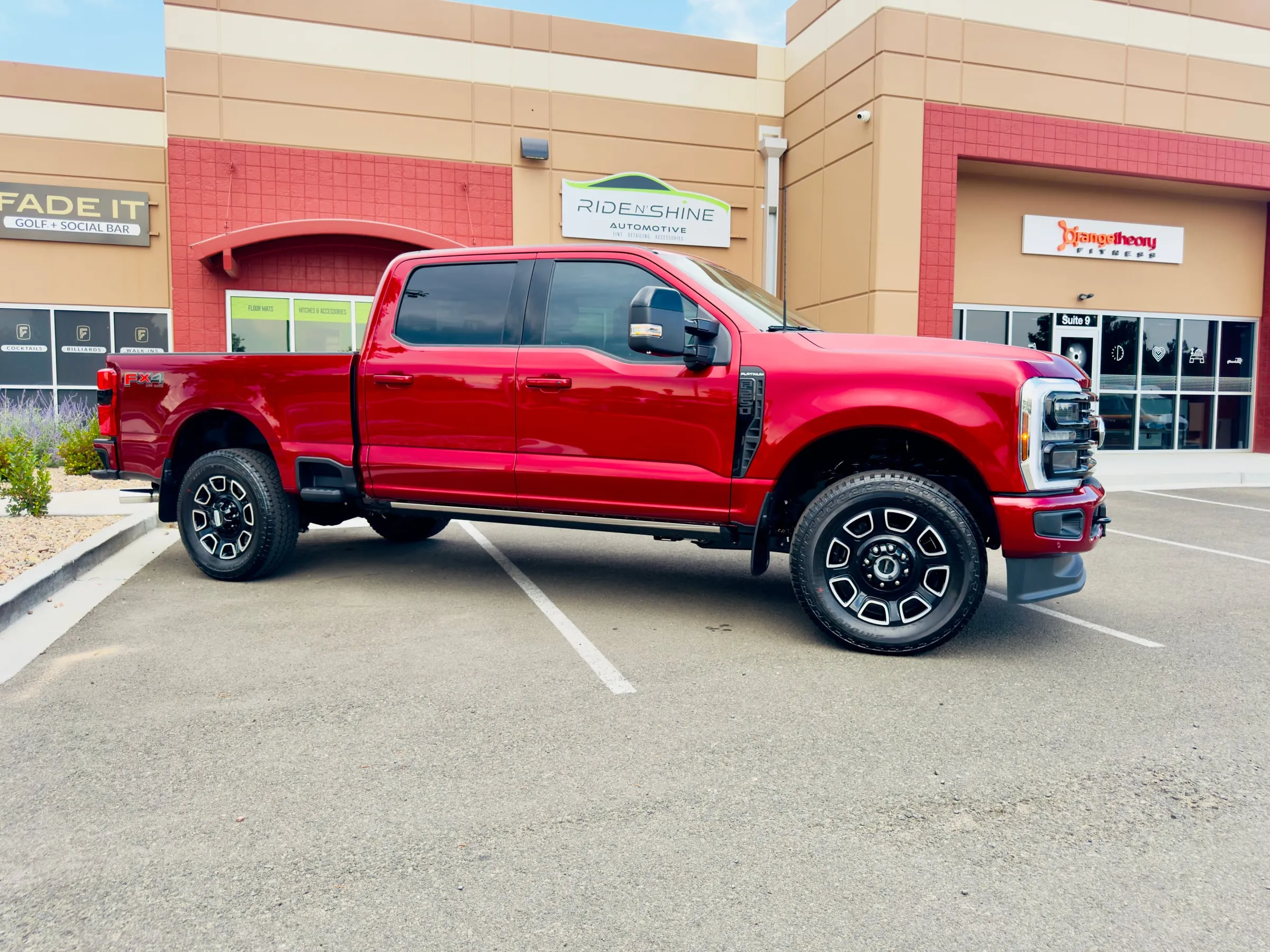
Colorado adds one more factor: mountains. CDOT lists the Eisenhower Tunnel’s approach grades at 7 percent on the west side and 6 percent on the east, and the tunnel sits above 11,000 feet. Long descents cook unprepared trailer brakes, and thin air costs a naturally aspirated engine power: Garrett, the turbocharger maker, puts it at about 3 percent for every 1,000 feet of climb. A setup that feels fine on flat ground gets examined honestly up here.
Start with the right hitch
The hitch is the connection between truck and trailer, and “I need a hitch” is not enough information. A 4,000-pound utility trailer, a 9,000-pound travel trailer, and a 15,000-pound fifth wheel have different requirements.
Before recommending one, we want to know the truck, its towing capacity and receiver size, the trailer’s loaded weight, the tongue or pin weight, the coupler type, the drop or rise required, and how often and where you tow. Then the system gets built around the actual trailer instead of the biggest hitch on the shelf. Our trailer hitch installation page covers the receivers, wiring and brake controllers we fit.
B&W Tow & Stow and Weigh Safe: the two adjustable hitches we recommend
Most truck owners tow more than one thing: a utility trailer on Monday, a boat on Friday, a camper next month. Different trailers have different coupler heights and ball sizes, and an adjustable hitch levels each one without a pile of ball mounts. We recommend both of these, and the trailer decides which.
The B&W Tow & Stow pairs serious-duty construction with an adjustable design that is easy to live with. Set the ball height for the trailer at hand, and when you are done towing, rotate the hitch and store it under the truck instead of leaving a ball hanging behind the bumper. That is where the name comes from.
It suits utility, boat and equipment trailers, smaller campers, work trucks, and any household that switches between trailers.
Weigh Safe adjustable drop hitches solve a different problem: knowing what is happening at the hitch. Tongue weight drives trailer stability. Too little invites sway; too much overloads the rear axle and lightens the steering. Many Weigh Safe hitches build a scale into the ball mount, so the built-in gauge replaces guessing with a number. That makes it the one we recommend for a load whose balance changes from trip to trip.
Weigh Safe covers the receiver sizes, drops, ball sizes, and weight ranges that matter, which helps on lifted and leveled trucks where a stock ball mount leaves the trailer nose-high. A truck sitting several inches over stock needs real drop, and the trailer should sit level when loaded: a nose-high or nose-low trailer shifts weight between its axles and shows up as poor handling, uneven tire wear, and weaker braking.
Getting that number right takes two measurements, one at the receiver and one at the coupler. Our drop hitch sizing guide walks through both, plus the ground clearance check that decides how much drop is too much.
Do you need a weight distribution hitch?
As travel trailers get heavier, an adjustable ball mount stops being the whole answer.
A conventional trailer puts its tongue weight behind the truck’s rear axle. As that load grows, the rear suspension compresses and weight comes off the front axle. You feel it as rear-end sag, light steering, headlights aimed at the trees, and twitchiness in crosswinds or truck wash.
A weight distribution hitch redistributes part of that tongue load across the truck and trailer axles. For travel trailers we like Weigh Safe’s True Tow systems, which come in configurations matched to trailer weight rather than treating every camper the same. Bigger is not automatically better; an oversized system is the wrong system for a lighter trailer. We size it to the measured combination. See weight distribution hitches for the systems we install.
Tongue weight matters more than most owners realize
Trailer weight gets the attention; tongue weight decides how the combination behaves. Conventional trailers are typically set up with about 10 to 15 percent of loaded trailer weight on the tongue, subject to the manufacturer’s requirements. Fifth wheels and goosenecks carry more on the pin, typically 15 to 25 percent. A 10,000-pound loaded trailer carries roughly 1,000 to 1,500 pounds on the tongue, which is a major load hanging behind the rear axle. Measure it and the hitch and suspension decisions get easy.
Air bags: one of the best towing upgrades for trucks
If the truck squats when the trailer connects, air bags (also called air springs) are a great upgrade. They supplement the rear suspension, and pressure adjusts to the load: low when empty, higher with the camper on. Done right, they reduce sag, keep the truck level, and steady the ride for trucks that alternate between empty commuting and heavy weekends.
One thing air bags do not do: increase your truck’s GVWR, payload, axle ratings, or towing capacity. They help the suspension manage an allowable load. They do not make an overloaded truck safe.
We install Air Lift and Firestone air springs, both vehicle-specific, and Timbren SES rubber springs for owners who want support without air. Air Lift is usually our first recommendation, and the truck and the load decide the kit. The bigger decision is usually onboard air: a compressor lets you adjust pressure from the cab or a wireless controller instead of hunting for a gas station hose. Drop the trailer and lower the pressure; hook up the camper and raise it; load the bed and adjust again. If you tow regularly, install the compressor with the bags.
Air bags vs. weight distribution: do you need both?
They do different jobs. Air bags support the truck’s rear suspension; weight distribution redistributes tongue load through the hitch connection. Bags do not eliminate the need for weight distribution, and a weight distribution hitch does not make bags pointless. For some travel-trailer setups both make sense. The truck, trailer, and measured tongue weight decide.
Trailer brake controllers
Getting a heavy trailer moving is not the scary part; stopping it is. A brake controller runs the trailer’s electric brakes in coordination with the truck. Many newer trucks have one from the factory; if yours does not, an aftermarket controller (we lead with CURT and Husky) may be required depending on the trailer.
The 7 percent grade coming down the west side of the Eisenhower Tunnel toward Silverthorne is a brake test you want to pass the first time. Proper trailer braking is the difference between a controlled mountain descent and a bad story.
Fifth-wheel hitches
When trailers get big, many RV owners move to a fifth wheel. The hitch mounts in the truck bed and puts the connection near the rear axle, which is why big fifth wheels tow so much more calmly than the same weight on a bumper.
We install B&W fifth-wheel and gooseneck hitches, built around heavy-duty American-made construction. Pair one with the B&W Turnoverball mounting system and the hitch comes out when you are not towing, giving the bed back for the work week.
B&W Turnoverball gooseneck hitch
For equipment trailers, horse trailers, and flatbeds, the Turnoverball gooseneck hitch is our first recommendation: the ball mounts in the bed and flips over flush when you are not using it. Tow when you need it, flip the ball over when you don’t, and the bed goes back to being a bed.
Fifth wheel vs. gooseneck: what’s the difference?
| Fifth wheel | Gooseneck | |
|---|---|---|
| Connection | Jaw-and-kingpin hitch in the bed | Bed-mounted ball |
| Standard for | RVs and fifth-wheel campers | Equipment, horse, and agricultural trailers |
| Bed when not towing | Removable with Turnoverball mounting | Ball flips flush into the bed |
Both put the connection in the bed, near the rear axle. Neither is universally better; the trailer’s coupler decides which one you need. Our 5th wheel vs gooseneck comparison covers capacity, ride, bed space and lifted trucks.
Don’t forget your truck’s payload
The most overlooked number in towing. A truck can advertise a big maximum tow rating that most configurations of that truck cannot legally carry, because payload has to cover the driver, passengers, cargo, accessories, and the tongue or pin weight. A fifth wheel can sit within the advertised towing capacity and still put enough pin weight in the bed to blow past available payload. Check the ratings on the door jamb of the specific truck, not the number in the ad.
Tires matter too
Tires are part of the system: load rating, condition, inflation, age, and wheel capacity on the truck, plus the trailer’s tires. Large aftermarket wheels and tires change how a truck tows, so if you are building for looks and towing, sort the towing requirements before choosing the wheel package.
What about lifted or leveled trucks?
A lift does not end your towing career, but it changes the geometry: more hitch drop, a different weight-distribution setup, and often air bags. Adjustable systems from B&W and Weigh Safe exist for exactly this. The goal stays the same: trailer level, weights measured, ratings respected.
Our travel trailer setup sequence
For a Colorado truck towing a real travel trailer, we evaluate in this order: verify the truck’s ratings (GVWR, payload, axles, receiver, tow rating); weigh the trailer as it will actually be loaded; measure tongue weight rather than guessing; select the hitch, adjustable or weight-distributing, to match; evaluate the rear suspension and add Air Lift or Firestone bags if the truck needs support; add onboard air for frequent load changes; verify the trailer brake system and controller; and check tires, because the best hitch cannot fix an overloaded sidewall.
Common questions
Do you need a weight distribution hitch?
Air bags vs. weight distribution: do you need both?
Do air bags increase towing capacity?
What's the difference between a fifth wheel and a gooseneck?
Where these numbers come from
Sources
Every rating and figure on this page comes from the manufacturer or the state. Checked 3 October 2026.
- CURT, how to measure tongue weight: tongue weight about 10 to 15 percent of gross trailer weight
- Weigh Safe, tongue weight for every trailer type: 10 to 15 percent for conventional trailers, 15 to 25 percent for fifth wheels and goosenecks, follow the manufacturer’s numbers
- Air Lift, air suspension myths: air springs do not change GVWR, GCWR or GAWR
- Timbren, do helper springs increase towing capacity?: helper springs do not increase payload or towing capacity
- CDOT, Eisenhower-Johnson Memorial Tunnel: 7 percent west approach, 6 percent east approach, average elevation 11,112 feet
- Garrett Motion, altitude and engine power: about 3 percent power loss per 1,000 feet for a naturally aspirated engine
Professional towing accessory installation in Arvada, Colorado
Ride N’ Shine Automotive sells and installs towing equipment for customers throughout Arvada, Golden, Wheat Ridge, Lakewood, Westminster, Broomfield, Boulder, Denver, and the Front Range: B&W hitches (Tow & Stow, fifth wheel, Turnoverball), Weigh Safe drop hitches and weight distribution, Air Lift and Firestone air bags, onboard compressors, CURT and Husky brake controllers, receivers, wiring, suspension, and wheels and tires. Most importantly, we make sure the pieces work together.
Towing gear also needs somewhere to live; our DECKED drawer systems page covers keeping hitches, straps, and chocks organized in the bed.